
An undersized umbrella leaves portions of your seating area exposed to direct sun, forcing people to shift chairs throughout the day or abandon the space during peak heat. An oversized umbrella crowds the area, interferes with movement and may require excessive base weight to remain stable in the afternoon breeze. The right size provides complete coverage for your intended use while fitting proportionally within the available space.
Proper sizing also affects how the umbrella performs as the sun moves, and one sized correctly for your table or seating arrangement maintains effective shade coverage across these variations rather than requiring constant adjustment.
Centre-post vs Side-post Design
Centre-post umbrellas feature the traditional design with a pole through the center of the canopy. This style works well for standalone applications where the pole doesn’t interfere with furniture placement.
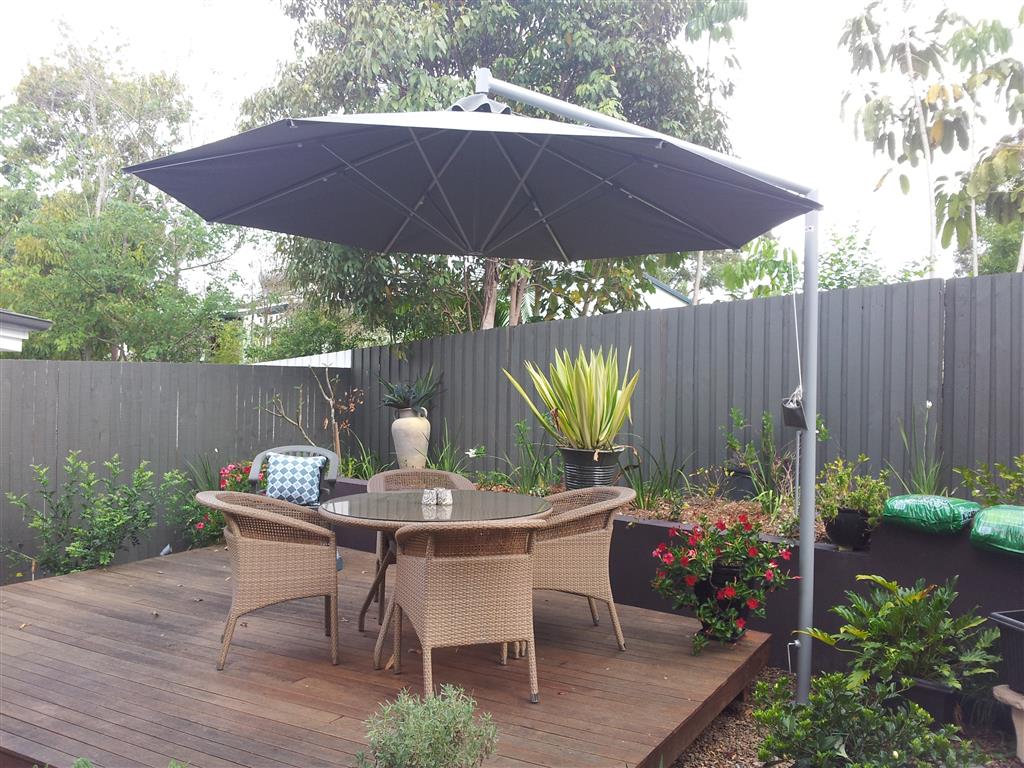
Side-post (cantilever) umbrellas extend up and out from the side, with the canopy hanging sideways over the shaded area. This offset design eliminates the center pole obstruction, making it ideal for dining tables, pool loungers, outdoor sofas, and situations where maximum usable space matters. The suspended canopy provides flexible positioning and can often be rotated or adjusted to follow sun movement throughout the day.
Sizing Guidelines for Common Outdoor Setups
Understanding the relationship between your outdoor area and appropriate umbrella size helps guide the design process. The umbrella canopy should extend at least 60-70cm beyond the edge of the area you want to shade. This overhang ensures people seated around a table remain in shade, not just the table surface itself. Here are general sizing considerations for typical outdoor furniture:
Dining Tables:
- 2-4 person table (90-120cm diameter/square): 2.5m canopy minimum
- 4-6 person table (120-150cm): 3m canopy
- 6-8 person table (150-180cm): 3.5m canopy
- 8+ person table (180cm+): 4m canopy or multiple umbrella configuration
Lounge and Pool Areas:
- Single lounger: 2-2.5m canopy
- Double lounger or 2-seater sofa: 2.5-3m canopy
- Sectional seating (3-4 pieces): 3.5m canopy or cantilever design
- Full poolside setup: Multiple umbrellas or large cantilever configuration
Balconies and Compact Spaces:
- Small balcony (2-3sqm): 2-2.2m canopy
- Medium balcony (4-6sqm): 2.5m canopy
- Courtyard dining: 2.5-3m depending on table configuration
Commercial Applications:
- Restaurant outdoor dining: Custom sizing based on table layout and coverage requirements
- Café seating areas: Multiple umbrellas designed for consistent coverage
- Business premises: Heavy-duty commercial-grade umbrellas engineered for durability

Measuring Your Space Accurately
Start by measuring the furniture or area requiring shade, so for dining tables measure the longest dimension and add 120-140cm to determine minimum umbrella diameter. This calculation provides the 60-70cm overhang on each side.
Next, verify clearance to surrounding structures. Measure from the umbrella’s proposed location to nearby walls, roof overhangs, fences and other obstacles. The canopy needs at least 30cm clearance on all sides when fully extended to avoid contact during wind movement or when opening and closing.
Consider vertical clearance as well as market style umbrellas with center poles require adequate height between the table surface and the canopy. Most dining setups need 2-2.2m of clearance from ground to canopy bottom for comfortable headroom when standing.
Shape Selection for Coverage Efficiency
Outdoor umbrellas are available in variety of shapes, and each suited to different applications and aesthetics.
Round and octagonal canopies for instance suit circular or square tables and create a traditional aesthetic. They provide even radial coverage but may leave corner gaps on rectangular tables.
Square and rectangular canopies match elongated dining tables more efficiently, eliminating the coverage gaps that round umbrellas create at table ends. They also work well for defined rectangular spaces like narrow balconies or deck sections.
Understanding Canopy Measurements
Umbrella sizing refers to canopy diameter when fully open, measured at the widest point. A 3m umbrella has a 3m canopy diameter, creating approximately 7 square metres of shade coverage. However, effective shade area is smaller due to sun angle, as direct overhead sun provides full coverage, while morning and afternoon angles reduce the shaded footprint.
Square canopies are measured along one edge, so a 3m square umbrella provides 9 square metres of coverage, delivering more total shade than a 3m round canopy. This makes square designs more efficient for larger rectangular tables.
Verify measurements when comparing models. Some manufacturers specify arc measurements (the curved distance across the canopy) rather than diameter, resulting in inflated size claims. Always confirm you’re comparing true diameter measurements.
Custom Design and Professional Installation
Choosing the right outdoor umbrella comes down to three things:
- Accurate measurements
- Understanding how your space is actually used
- And matching the design to your furniture layout
Use the sizing guidelines above as your starting point, account for sun angle and movement throughout the day and don’t overlook the practical difference between the designs for your specific setup. If your space has unusual dimensions or you want something tailored rather than off-the-shelf, a custom designed umbrella ensures you get coverage, proportion and aesthetics exactly right.